













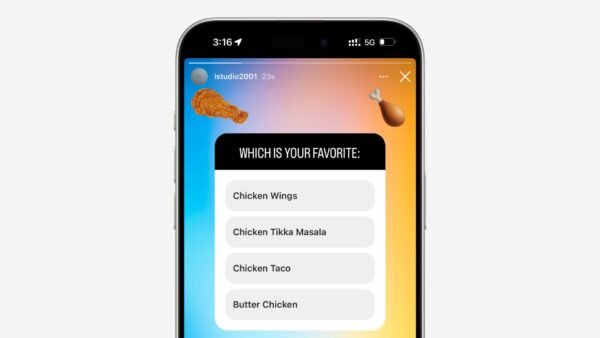
Most guides say the same thing about polls: “they boost engagement.” That’s true, but it’s an outcome, not a mechanism. The real question is different: what exactly happens between the moment a follower taps an option and the moment 40% more people see your next Stories? Understanding that chain is what separates those who place polls “to tick a box” from those who steer their own reach.
In 2026 this matters more than ever. According to Metricool, average organic reach on Instagram fell by roughly 31% over the year while publishing volume rose 21%. The algorithm got stingier with impressions — and the poll went from a nice touch to one of the few levers that can still nudge that algorithm.
What the algorithm actually “hears” when someone votes
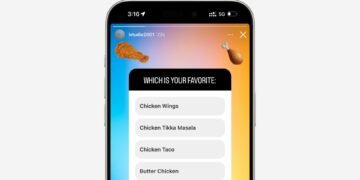
For Instagram, a tap on a poll isn’t “a slightly stronger like.” It’s an interaction event of a specific type, and the system reads several things out of it at once.
First, the fact of a response: the follower didn’t just view the frame, they took an action. Second, the speed of that response relative to the moment of publishing. Third, the fact that the person lingered on the frame long enough to read the question and choose. Each of these signals is weak on its own, but together they add up to the conclusion the 2026 algorithm values most: “there’s a live connection between this account and this viewer.”
And connection is currency. The more confident the algorithm is that people respond to you, the more willingly it shows your future Stories both to that person and to others like them.
Note: the algorithm evaluates not the poll itself but the behavior around it. The same sticker in a good frame and a bad one sends completely different signals. A poll is a prompt for action, and it’s the action that does the work.
The four ranking inputs a poll touches
Story distribution is built on several behavioral inputs. A poll touches four of them at once — and that’s its strength compared with a plain static frame.
| Signal | What it means | How a poll affects it |
|---|---|---|
| Response rate | How many viewers took an action | A low tap barrier yields a high rate |
| Response speed | How fast reactions came after publishing | A poll prompts action right away, not “later” |
| Time on frame | How many seconds the viewer watched | Reading the question holds longer than static |
| Connection strength | How close the account–viewer contact is | Repeated interactions reinforce it |
A static frame, at best, affects one input — view time — and even that weakly. A poll hits four at once. That’s exactly why Stories with a poll average noticeably more engagement than plain ones: it’s not “sticker magic,” it’s that the sticker activates several ranking levers simultaneously.
Why the first hour decides more than the rest of the day
The most underrated factor is the speed at which interactions accumulate right after publishing. The algorithm makes an early decision: whether to roll this story out to a wider audience or keep it within a narrow circle. And that decision leans heavily on how quickly the first responses came in.
A self-reinforcing loop operates here. A poll that already has votes looks alive, and viewers join more willingly — nobody wants to vote first into a void. More early votes means a stronger early signal, which means wider distribution, which means even more votes. A poll that stalls in the first hour never enters that loop, however good the question is.
Hence the practical takeaways:
- Post the poll at your audience’s peak — when followers are online, critical mass builds faster.
- Tease the vote in advance, in the previous frame or a post, so responses start immediately.
- Don’t scatter attention: one strong poll in a series will get more early votes than three weak ones spread across frames.
Sometimes brands need to break through exactly this starting barrier — when the audience is still small and the poll sits empty for the first hours. One tactic is to give it an artificial first push: some teams use a paid kickstart, buy instagram poll votes through services staffed by real workers, so the poll looks active from the start and triggers that very loop. It works on the same logic as “seeding” the first likes under a post: visible activity removes the fear of being first.
Warning: a starter push accelerates the loop but doesn’t create it. If the question doesn’t grab people, organic won’t pick it up and the early signal fades. A paid push is the match, not the firewood; the content has to burn.
The DM effect: how a poll strengthens the connection for the long run
A poll has a follow-on that affects the algorithm more than a one-off tap. When you reply to voters — with a reshared result, a follow-up frame, or better yet a DM — you move a light interaction into the category of conversation. And personal contact in DMs is what the 2026 algorithm treats as the heaviest signal of account kinship.
This is a crucial point. A poll on its own is a medium-strength signal. But it opens the door to strong ones. The scheme that works: the poll collects a broad response, then you reach the most active voters in DMs — and each such dialogue raises your “connection” with that person, which makes them start seeing your stories more often overall.
So a poll is best seen not as an endpoint but as the top of an interaction funnel: tap — reply — dialogue — durable connection.
Completion rate and where to place the poll in a series
Another ranking input is whether people watch your series to the end. If they drop off on the first frame, the algorithm concludes the content doesn’t hold and trims impressions. A poll works two ways here.
On one hand, a poll in the first or second frame gives the viewer a reason to linger and take an action while they haven’t left yet. On the other, if you stick the poll in too late, only a small share will see it — the already-departed audience won’t reach it.
Pro Tip: place the poll near the front of the series — the first or second frame. That way it gathers the most votes and simultaneously holds the viewer at the entrance, improving the completion rate of the whole series.
The flip side: how polls can sink your reach
A poll isn’t an unconditional good for the algorithm. Misuse produces the opposite effect, and brands often don’t notice.
The main trap is a poll in every series. The audience learns fast: if there’s never a point behind the sticker, they stop noticing it. The response rate drops, and a falling response rate is itself a negative signal. The algorithm sees that your stickers get ignored and starts showing your stories more narrowly.
The second trap is a poll with no “reveal.” If you never show the result or the decision from a vote, people stop believing their voice matters and stop voting. The engagement loop breaks.
| What you do | How the algorithm reads it |
|---|---|
| Poll with a meaningful question, high response | Strong connection, show it wider |
| Poll in every frame, response drops | Stickers ignored, narrow the reach |
| Poll plus a DM reply | Strongest connection, priority in the story tray |
| Poll with no result, response fades | Engagement is hollow, weight falls |
How to see the effect in your insights, instead of imagining it
To tell whether a poll is working on reach, look at ratios, not absolute numbers. The key metric is participation rate: votes divided by frame views. If 1,000 people saw the frame and 180 voted, that’s 18%, and that share matters more than the 180 itself.
Next, compare the reach of series with a strong poll and without one — and, more importantly, look at the share of impressions to non-followers. A rise in that share means the algorithm started rolling you out to cold audiences, and that’s real reach growth, not a reshuffle of the same viewers.
Note: a one-off spike proves nothing. Look at the participation-rate trend over two or three weeks. Rising means your questions are landing and the algorithm responds with impressions. Falling is the earliest sign it’s time to change the format — and it shows up before overall reach drops.
Three myths about polls and the algorithm
- Myth: more polls, more reach. In reality, a cadence above the reasonable trains the audience to skip, and reach falls. The quality of the question decides, not the number of stickers.
- Myth: only the vote count matters. The algorithm cares more about the share who responded and the speed, not the absolute number. A hundred votes on a thousand views is stronger than the same hundred on five thousand.
- Myth: the poll itself lifts you in distribution. What lifts you is the behavior around the poll — responses, completions, the DMs that follow. An empty poll with no reaction gives nothing.
Frequently asked questions
Is it true that polls lift reach?
Indirectly, yes. The sticker doesn’t rank on its own, but it prompts actions (taps, completions, DMs) that the algorithm uses as ranking inputs. The stronger those actions, the wider the distribution of your next stories.
Why did my poll collect votes but reach didn’t grow?
Most likely the votes came slowly and late, after the algorithm had already made its early distribution decision. Or the poll sat in every series and the audience reacts to it as a formality. Look at response speed in the first hour and at participation rate.
How often should I run polls without doing harm?
For daily Stories — one or two meaningful polls a week, each with a result revealed afterward. A poll in every frame works against you.
Does a paid push help the algorithm?
It helps clear the starting barrier of the first hours, when there’s no visible activity yet, and triggers the early-response loop. But only on top of a good question: without an organic pickup, the early signal fades.
What affects the algorithm more — a poll or the question sticker?
The question sticker sends a stronger signal because it opens a DM conversation. A poll sends a more massive but lighter one. The strongest approach is the combo: a mass poll plus DMs with the most active voters.
What follows from this
A poll affects the algorithm not through sticker magic but through the behavior it sets off. A tap is a response, speed, time on frame, and — if you carry it into DMs — a strong connection. All four are inputs Instagram uses to decide who sees your stories and how widely.
Hence the working strategy. Place a poll with intent, and not in every frame. Move it to the front of the series and launch it at peak activity to catch the early response. Close the loop — show the result and go into DMs with the most active voters. And help a new poll get off the ground, so an empty sticker doesn’t kill the signal in the first hour. Then the poll stops being decoration and becomes what it can actually be — a tool for managing reach.
Start with one: on your next series, put a strong poll in the first frame, launch it at peak, and check the participation rate an hour later. That’s your baseline — everything else grows from it.